What’s The Perfect Bowling Ball Weight Formula For Better Bowling?
By Jeroen Kooij, Editor · Updated 2026
Most adults bowl best with 14–16 lb (men) or 10–14 lb (women). The common starting point: roughly 10% of your bodyweight, capped at the USBC max of 16 lb. Kids match weight to age (a 10-year-old uses a 10 lb ball, up to 12 lb).
Heavier hits harder — but only if you can throw it with control. Lower the weight before your form breaks down.
What we cover in this guide
How Much a Bowling Ball Weighs and How to Choose the Right Weight for Your Game
Bowling balls come in different weights, with an average of between 6 and 16 pounds. The average adult male will use a ball that weighs between 14 and 16 pounds, with females requiring a ball of between 10 to 14 pounds. It is very important to determine how much a bowling ball weighs to prevent any issues with your back.

The weight of the ball greatly influences the impact it will have on the pins. If you have two balls of different weights, the heavier one will hit the pins harder than the lighter one. A heavier ball may also cause injury to the bowler, and therefore, a balance needs to be maintained when selecting the optimal bowling ball. Having the heaviest bowling ball is not a guarantee that you will hit all the pins. This is because your throwing speed greatly reduces when you are using a heavier ball. When speed is low, the amount of force required to topple the pins greatly reduces.
What our own labels said, and what the balls were sold as
First-hand note · our own pro shop visit, July 2026
Every weight on this page is a shelf weight: the number in the listing you buy from. In July 2026 we took two new balls to a pro shop to have them drilled, and we photographed both box labels before the packaging went out. Both balls were sold as 14 lb. Neither label read 14 lb. One read 14 lb 4 oz, the other 14 lb 3 oz.
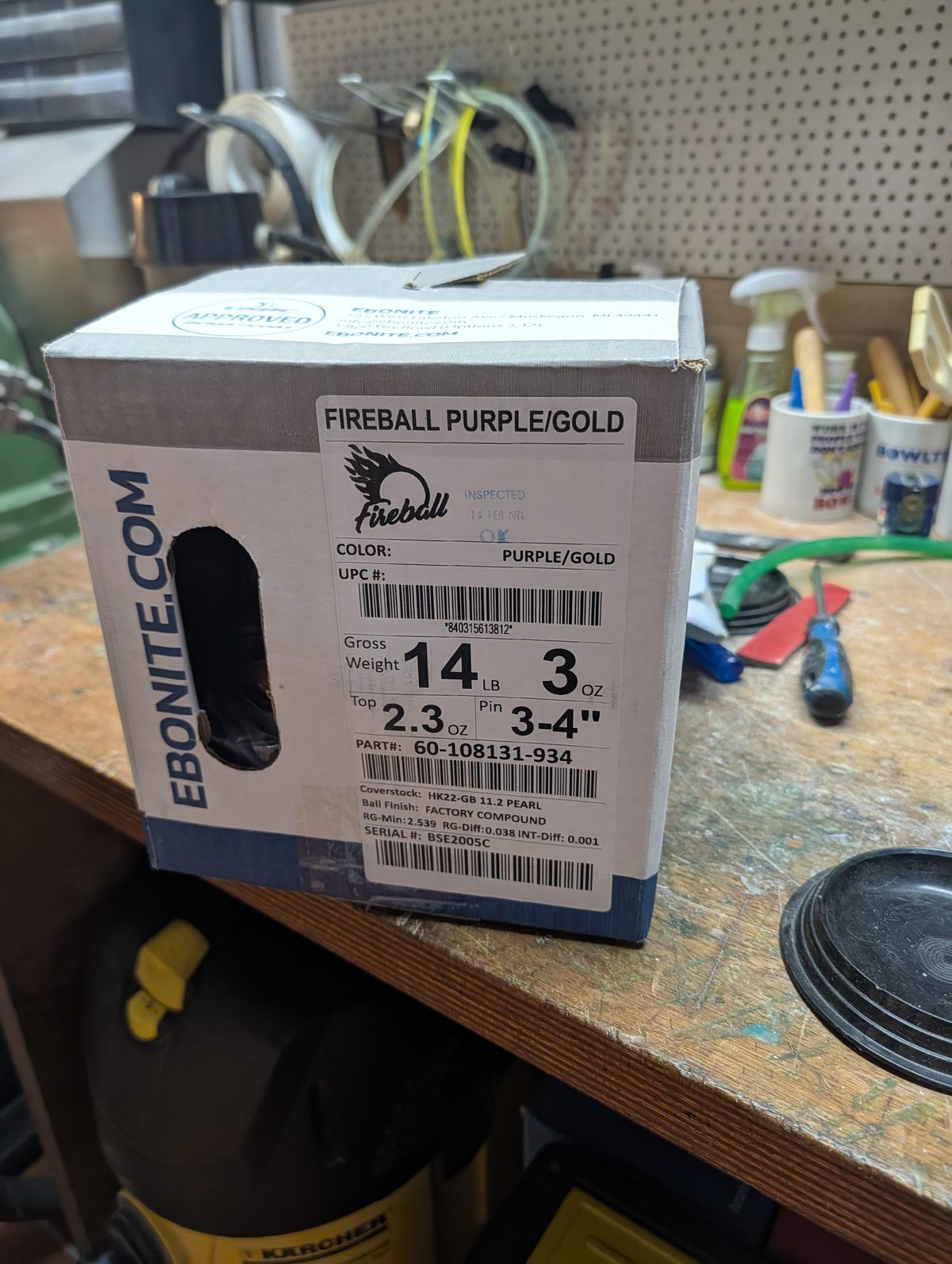
That field is the gross weight of the ball as it left the factory, before any holes are cut. The USBC Equipment Specifications and Certifications Manual caps a bowling ball at 16.00 pounds and sets no minimum, and that ceiling applies to the finished, drilled ball rather than to the undrilled blank. Drilling takes material out, so the figure printed on the box is not the weight of the ball you eventually carry either. We have not weighed ours since, so we are not going to put a number on the difference.
The practical consequence for the tables above is simple: an advertised weight is a band, not a measurement. If you are choosing right at the edge of what you can control, a few ounces either side of the number on the listing is real, and it is printed on a box most people throw away the same day. We go through the rest of the fields on that label — top weight, pin distance, RG and differential, serial number — in our bowling ball drilling guide.
Shopping bowling ball guide
When selecting the best bowling ball, pay careful attention to the finger holes as their size will indicate whether the ball will accommodate the bowler’s weight. When the holes are too large or too small, it could mean that the bowling ball weight will either be heavier or lighter; ensure you get the perfect fit. For a comprehensive guide on choosing the right bowling ball, explore our top picks.
The bowler’s weight and height also determine the size of the ball that one selects. If you have back problems, select a bowling ball that is lightweight.
For children, the generally accepted principle for bowling ball size and weights is to use the child’s age when selecting a ball for them. If a child is 10 years old, choose a ball that is 10 pounds, and if the child is 12 years old, select a ball for them that weighs 12 pounds.
It is often repeated that 12 pounds is the legal minimum. It is not. The USBC Equipment Specifications and Certifications Manual sets a maximum of 16.00 pounds and no minimum weight at all. What 12 lb actually represents is the lightest weight most manufacturers make performance balls in, which is a supply floor rather than a rule. If your child can handle 12 lb without the swing pulling them off balance, that is the point at which performance equipment becomes a real option rather than a house ball.
Some professionals have suggested dividing your body weight by 11 and 2 to get the ideal bowling ball. If you weigh, let’s say, 110 pounds, you divide this number by 11 to get 10 pounds; this would be the ideal ball for you. The mathematical formula is not set in stone, as other factors would come into play, like the material used to make the bowling ball.
Bowling Ball Weight by Body Weight (Quick Reference)
Bowling Ball Weight for Kids (By Age)
Don’t size up because the pro shop suggests it. If your last three frames look noticeably weaker than your first three, the ball is too heavy — regardless of what the chart says. Form fatigue costs more pins than weight gains.
Answer four quick questions and our free Bowling Ball Finder matches you to the right ball for your style, lanes and budget — plus a free buyer’s checklist, instantly.
Take the free Finder →Make the best of your throw
A conventional bowling ball consists of a core surrounded by a shell called a coverstock. This can be made of polyester, plastic, or resin. The weight of a bowling ball is usually determined by its inner core, and while it is held that the heavier a ball is, the more impact it makes on the pins, modern improvements on bowling balls have changed that. Modern bowling balls now have a special core that maximizes impact without necessarily increasing the weight of the bowling ball.
When you use materials like urethane or resin, they will greatly affect how much a bowling ball weighs. They usually help you strike the pins without adding any extra weight.
Best Bowling Balls 2026
Looking for our top equipment picks? Start with the full ball roundup.
Dynamics of a bowling ball
The bowling ball hits the pins at a force that is equal to speed times the mass. The weight of the bowling ball will play a crucial role in striking more pins, but the speed at which you throw the ball is also a key determining factor. A ball weighing 12 pounds traveling at a speed of 16 miles per hour will have a greater impact than a ball weighing 14 pounds but traveling at a speed of 13 miles per hour. The heavier a ball is, the more speed you will need to hit the ball; this puts extra strain on yourself to make a good throw. The average speed of most bowling balls is usually 16 miles per hour. Performance-enhancing cores greatly reduce the weight of the bowling ball without any decrease in its speed. Modern bowling balls have reduced the need to know how much a bowling ball weighs, as they are greatly enhanced to perform better.
For those thinking of taking bowling to the next level, you can consider having custom-made drills for your fingers. This will help to distribute the bowling weight evenly around your body. Custom-made drills come at an extra cost. You can also have bowling balls made according to specific colors, or you can have your name engraved on them.
Urethane and resin coverstocks are a good match when you are throwing a hook, as they grip the lane better than plastic balls. When selecting the best bowling weight for hook, resin is preferred to urethane as it does not hook too much when it cuts through oil. At the end of the lane, it will increase friction and offer back-end to pins; this enhances your strike potential.
Plastic bowling balls are the most common balls you will find in bowling alleys. They are inexpensive and help players throw the ball straight, but they are also less versatile.
Bowling is an excellent game for both you and your family. How much a bowling ball weighs will determine the type of ball that you select. You should check your weight before you purchase a bowling ball, as this will influence the type of ball. People who have perennial back pain problems should be extra careful when selecting their bowling balls. With modern improvements, we are seeing marketers coming up with lighter balls that deliver quite the force when you are throwing. You will find bowling ball weight guides in most of the bowling alleys that you visit.
The right weight is critical if you are to maximize your potential in the game. It also prevents you from getting muscle injuries, which can become fatal.
Frequently Asked Questions About Bowling Ball Weight
What is the maximum legal weight for a bowling ball?
16 pounds is the maximum allowed by the USBC for sanctioned league and tournament play. Anything heavier is not legal for scoring.
Is a heavier bowling ball always better?
No. Pin carry is speed times mass, plus revs. A 14 lb thrown clean at 16 mph beats a 16 lb with broken form at 12 mph.
How do I know if my bowling ball is too heavy?
Three tells: scores drop in games two and three; you feel strain in shoulder, wrist, or lower back; or your release breaks down by frame seven. Any one is a signal to drop a pound.
What weight do professional bowlers use?
Most PBA pros throw 15 or 16 lb. Some two-handers have moved to 14 lb. The trend is downward as tech lets lighter equipment match heavier carry.
Can an adult man bowl well with a 14 lb ball?
Yes. Many league bowlers in their 50s and 60s drop from 16 to 14 lb and average more, not less — release stays clean across the full set.
Does ball weight affect how much it hooks?
Indirectly. Coverstock and surface determine hook potential. Weight affects whether you can deliver the ball with proper rev rate — too heavy flattens your release and kills hook.
What is the 10% rule for choosing bowling ball weight?
Pick a weight roughly equal to 10% of your bodyweight, capped at the USBC max of 16 lb. A starting point — let your form, not the formula, make the final call.
How does a pro shop drill make a ball feel lighter?
A fingertip grip with the right span and pitch transfers weight more efficiently than a conventional grip. A well-fitted 15 lb feels lighter than a poorly fitted 13 lb.
Related guides
- Best bowling balls 2026 — expert picks across skill levels
- How to read bowling lane conditions — the foundation of ball selection
- Best bowling shoes 2026 — slide consistency starts with your shoes
- Bowling spare shooting guide — pick up the 7-pin, 10-pin, and tricky splits
- Bowling ball cleaning & maintenance — protect your investment
Edited by Jeroen Kooij
Editor · ExpertBowler
Editor of ExpertBowler. Responsible for editorial standards and accuracy of bowling technique, equipment, and lane play guidance. Cross-references USBC coaching materials, published bowling instruction, and verified league-bowler feedback. Read more about our editorial process.
Editorial standards: Technique advice cross-referenced with USBC coaching materials and published bowling instruction. We do not accept paid placements.
Updated: 2026.
Sources & references
- USBC coaching materials: bronze, silver, gold-level coaching curricula for technique fundamentals
- Manufacturer technique guides: official brand instructional resources and equipment documentation
- Community feedback: verified threads on BowlingForums.com and Reddit r/Bowling
- Published bowling instruction: Bowling This Month, Bowl.com instructional resources
- USBC equipment specifications: approval lists plus the Equipment Specifications and Certifications Manual for maximum ball weight and the absence of a minimum
- Our own pro shop visit, July 2026: box labels of two new balls photographed and transcribed before drilling; gross weight figures on this page are read off those labels

Mass times speed is momentum, not force.
Sir, I do not mean this in a bad way but you are giving false information on weights of bowling balls, especially to children. A bowling ball is an investment of not only money but to a childs future in the sport, enjoyment and injury. As in the old days of saying weight should be 10% of body weight this is also a bad generalization of age to weight. I have been Coaching for over 45 years drilling for 12 of them and I have come an easy method, get a ball sling, or even a single bag and put a ball in it and watch the bowler’s shoulder, i dont care age or gender, and watch if their shoulder drops the ball is too heavy, keep trying until they do no drop their shoulder.
But momentum affects force, or power.